

Implant manufacturers rarely have a cleaning problem in the abstract. They have a specific one: a residue that keeps showing up on a validation swab, a cannulation that will not come clean, a porous coating that traps polishing compound, or an auditor asking how the final cleaning stage is controlled.
Those are different problems and they need different stages in the line. A medical implant cleaning machine is better understood as a set of process stations assembled for a particular part mix, which is why the specification has to be written from the parts upwards.
Greets Equipment is an authorised Indian dealer for Novatec S.r.l. of San Martino di Lupari in Italy, who build ultrasonic and precision cleaning lines for the medical device industry among others.
Why Implants Are Harder to Clean Than They Look
An implant is a small part with features designed to make cleaning difficult. Threads and cannulations hold liquid. Blind and tapped holes trap air, so cleaning fluid never reaches the bottom. Porous and plasma-sprayed coatings hold polishing compound in a structure specifically engineered to be open. Hollow screws and modular tapers have internal surfaces nobody can see.
Spray washing reaches these features poorly. Ultrasonic cavitation works into them, which is why ultrasonic immersion is the backbone of almost every implant cleaning line. Where the geometry defeats even that, a vacuum chamber pulls the trapped air out of blind and tapped holes so the liquid can reach the bottom.
The Stages a Line Is Built From
Novatec build implant lines on two platforms. PLURITANK is a modular multi-tank line, assembled from separate process stations, up to fourteen numbered ones. 2CRD is a single-chamber system where cleaning, rinsing and drying all happen in one chamber under vacuum, fed from three filtered buffer tanks.
Everything below is one of those two platforms configured for a particular job, rather than a separate machine. Few plants need all of it. Some of these routes do not combine on the same part. A porous plasma-sprayed surface is a poor candidate for either electropolishing or penetrant inspection, since one attacks the coating and the other leaves penetrant trapped in the pores. Settle this per part family at specification stage: a plant making both coated and uncoated implants is usually specifying two routes, not one.
In-Process Cleaning
Cleaning between manufacturing steps, not only at the end. A residue left on a part before the next operation can be smeared over and folded into the surface by a later cutting or polishing pass, or sealed beneath a coating, and at that point no final cleaning stage will recover it.
Novatec supply in-process cleaning either as a single-chamber 2CRD or as an in-line PLURITANK, depending on where it sits in the production flow and how many parts have to pass through it.
Vacuum Precision Cleaning
The 2CRD is built for the geometries that defeat immersion alone: blind and tapped holes, porous coated surfaces, and removing polishing pastes and oils from complex shapes. Because cleaning, rinsing and drying happen in one chamber, parts are not transferred wet between stations.
It is built in a range of chamber sizes, from 300 x 400 x 300 mm on the 2CRD-100 up to 600 x 1050 x 630 mm on the 2CRD-800, with a larger 2CRD1700 built to order at 800 x 1200 x 820 mm and 1000 kg. The 100, 200, 400 and 800 sizes are available static or, as the -ROT versions, with rotation and tilting, which matters for parts that would otherwise hold liquid in a pocket.
Spray Cleaning
Where the parts do not need immersion, Novatec also build a spray cleaning system with an unload air lock into the cleanroom. It appears on combined medical lines as the PFC configuration, usually alongside immersion stages rather than instead of them.
Electropolishing
An electropolishing line is built on the PLURITANK platform, adding an electropolish tank plus neutralisation and recovery rinsing stages. Novatec list it for stainless steel and titanium implants.
Keeping it on the same platform as the cleaning line has a practical payoff: one control system, one basket format, and parts that move from cleaning to electropolishing to final rinse without being rehandled between separate machines.
Final Cleaning and Passivation
The last cleaning stage before packing and sterilisation removes dust and handling residues picked up during manufacturing and inspection. Novatec build this as final cleaning, or as combined final cleaning and passivation, with an unload air lock that discharges directly into the cleanroom.
The air lock is the detail to settle early, because it determines how the line meets the cleanroom wall, and that is an architectural question as much as an equipment one.
Fluorescent Penetrant Inspection
FPI reveals flaws that break the surface: cracks, laps and fatigue indications. It will not find anything that does not reach the surface, so it sits alongside other methods rather than replacing them.
Novatec build the processing side as one automated line on the PLURITANK platform, combining the ultrasonic pre-cleaning, the surface preparation and the penetrant, emulsifier and developer stages. Reading the indications under UV-A remains a separate inspection task. Parts also have to be cleaned again afterwards, because penetrant and developer are themselves residues, so FPI sits in the middle of the cleaning sequence and not at the end of it.
Quality Verification and Basket Return
On a full automatic line, quality verification stations and a basket return air lock conveyor link the sections together. These are the modules that turn a set of process stages into a line that runs without an operator carrying baskets between them.
How a Complete Line Is Put Together
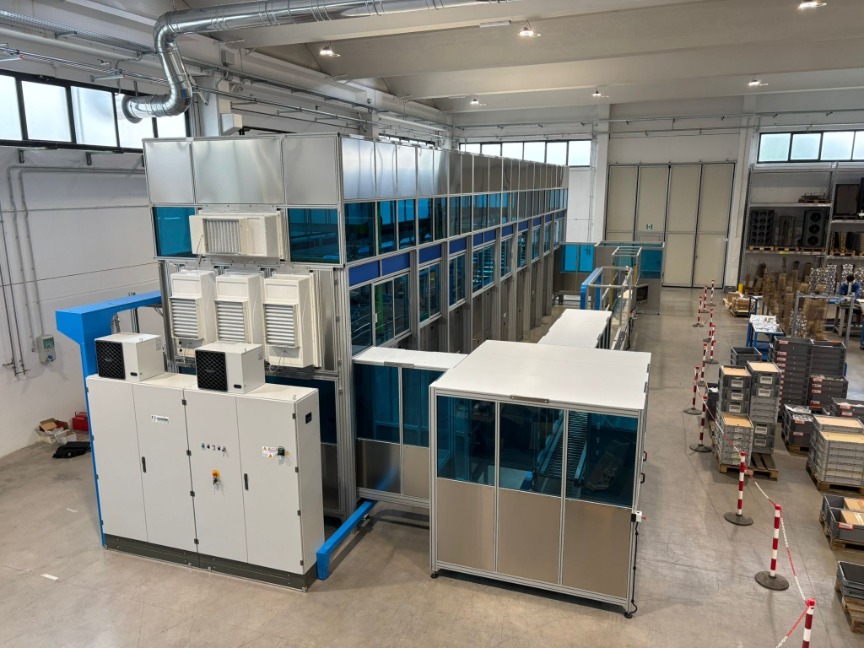
The PLURITANK 1400 is a useful illustration. It runs fourteen numbered process stations, with a motorised loading conveyor before them and a motorised unloading conveyor after:
- Stations 1 to 6: three ultrasonic cleaning tanks with basket agitation, each followed by a turbulent-flow rinsing tank
- Station 7: a demineralised water ultrasonic rinsing tank
- Stations 8 and 9: demineralised water rinsing tanks with slow drain, cascading back to tank 7
- Stations 10 to 14: a five-position hot air tunnel dryer
Alongside it: a buffer tank with filter and pump, two pump and filter groups, a demineralised water plant, an exhaust fan and a loading and unloading operator zone. Internal tank 700 x 1200 x 1650 mm, around 1386 litres, with a basket of 540 x 1090 x 1540 mm. The line is supplied in two overall widths; the tank size is the same in both.
The cascade between stations 8, 9 and 7 is a detail with an operating cost behind it. Rinse water from the last stages is returned to the earlier demineralised rinse, so the cleanest water meets the cleanest parts and demineralised water consumption falls.
Sizing the Line
PLURITANK numbers are tank volumes in litres rather than catalogue model numbers. Novatec build each line to the volume the job needs, from 50 litres up to around 1500 litres. So the model number is the output of the sizing exercise, not the input to it.
What to settle before anyone quotes:
- Part sizes and the largest part, which sets the basket and therefore the tank
- Batch quantity and monthly volume, which set the cycle time and the number of stations
- Basket load. Novatec handle automatic basket transfer from 10 kg to 300 kg and above
- Which stages the specification requires: in-process, final, passivation, electropolishing, FPI
- Cleanliness specification and how it will be verified, because that drives the chemistry and the rinse stages
- Whether the line unloads into a cleanroom, and what class
- Water supply and demineralised water capacity, and effluent handling
- Floor area. A full line is long: the PLURITANK 1400 footprint runs to about 19.5 by 7 metres in the wider of its two builds
What Changes When the Line Is Installed in India
Three questions come up on almost every Indian enquiry, and all three are cheaper to answer in the specification than after commissioning.
Incoming water quality varies widely by location, and a cleaning line that finishes in demineralised water is only as good as the water plant feeding it. On the PLURITANK 1400 the demineralised water plant is part of the line, rather than something assumed from house supply, and on any line it should be specified rather than assumed. The capacity has to be set against local feed water, not a European default.
Electropolishing and passivation stages produce acidic effluent. An Indian manufacturing plant needs State Pollution Control Board consent in any case; what these stages change is the effluent character and therefore the neutralisation capacity and what the consent has to cover. That belongs in the project plan from the beginning rather than at commissioning. And for manufacturers licensed under the Medical Devices Rules, 2017, the cleaning process is one of the processes that has to be validated; for anyone exporting, the destination market's requirements apply on top, which usually means the documentation set has to satisfy more than one reviewer.
Validation and Documentation
For implant work the equipment is only part of what you are buying. Cleaning is normally a process whose result cannot be fully verified by inspecting the finished part, which under ISO 13485:2016 clause 7.5.6 means it has to be validated, and the line has to produce the records that support it.
Raise these at specification stage: what process data the control system logs and in what form, what is available for IQ, OQ and PQ documentation, how the recipes are locked and who can change them, and how a deviation is recorded. These are easier to specify into a line than to add to one.
The validation is the device manufacturer's own responsibility, and so are the records; an auditor or notified body reviews that evidence rather than producing it. A line that cannot generate the data makes the job considerably harder.
Start With the Parts
The useful starting point is the parts: what they are, the material, the features that are hard to clean, the batch size and what the cleanliness specification says. The platform, the number of stations and the tank volume all follow from that.
Send us a description of the parts and the cleanliness specification, and we will take it to Novatec and come back with a proposed configuration and the questions still outstanding. Installation, commissioning and after-sales service on a Novatec line are provided by Novatec, and the arrangements are set out in writing for each order.
Contact Greets Equipment with your part drawings and cleanliness specification.
Frequently Asked Questions
- What is a medical implant cleaning machine?
- An automated line that removes machining oils, polishing compounds, particles and handling residues from implants and surgical instruments. It is normally built from ultrasonic immersion or spray cleaning stages, cascade rinsing in demineralised water and a controlled drying stage, with the final stages unloading into a cleanroom.
- Why is ultrasonic cleaning used for implants?
- Implants have threads, cannulations, blind holes and porous coated surfaces that spray washing reaches poorly. Ultrasonic cavitation works into those features. For the most difficult geometries, cleaning in a vacuum chamber pulls the trapped air out of blind and tapped holes so that liquid can reach the bottom.
- What is in-process cleaning and why does it matter?
- Cleaning between manufacturing steps rather than only at the end. Residues left on a part before the next operation can be smeared over by a later pass or sealed under a coating, and are much harder to remove afterwards. Novatec supply in-process cleaning as a single-chamber 2CRD system or as an in-line PLURITANK.
- Is electropolishing part of the cleaning line?
- It can be. An electropolishing line is built on the PLURITANK platform with an electropolish tank plus neutralisation and recovery rinsing stages. Keeping it on the same platform means one control system and one basket flow from cleaning through to final rinse.
- What is fluorescent penetrant inspection used for on implants?
- FPI reveals flaws that break the surface, such as cracks and fatigue indications. It will not find anything fully below the surface. Novatec build the processing side as one automated line on the PLURITANK platform, combining ultrasonic cleaning, surface preparation and the penetrant stages; reading the indications under UV-A is a separate inspection task.
- How large a line do I need?
- It follows from part size, batch quantity and how many process stages the specification requires. PLURITANK tank volumes run from 50 litres up to around 1500 litres, and a line can carry up to fourteen numbered process stations with automatic basket handling from 10 kg to 300 kg and above. The right starting point is your part mix and monthly volume, not a model number.