



Most people planning a PVD coating plant in India start with the coating machine. It is the expensive item and the obvious one. But a good deal of the trouble that shows up six months after commissioning comes from the steps around it, not from the coating chamber.
A coating only holds if the surface underneath it is clean. The substrate only performs if it was heat treated correctly first. And the chamber only runs if the utilities behind it were sized properly. What follows is the whole line, stage by stage, so the gaps turn up during planning instead of during production.
Greets Equipment is an authorised Indian dealer for Fours Industriels B.M.I. of France, Novatec S.r.l. of Italy and Guangdong Huasheng Nanotechnology of China. Between the three, the products cover the cleaning, heat treatment and coating stages. Inspection, fixturing and stripping are bought elsewhere, and they are where the planning gaps usually turn up.
The Six Parts of a Working Coating Plant
Only one of them is the coating machine.
- Pre-treatment and cleaning, to remove oils, machining residues and particles before coating
- Heat treatment, where the substrate needs hardening or tempering first
- The coating machine itself
- Utilities and fixturing: power, cooling water, process gases, compressed air and the jigs that hold the parts
- Inspection: coating thickness, adhesion and hardness checks
- Post-coat finishing and stripping, where the work requires it
Each stage sets requirements for the next. Fixturing that does not suit the chamber geometry reduces the number of parts per batch, and that changes the cost per piece for the life of the plant.
Cleaning Decides Whether the Coating Holds
Adhesion failures are the most common problem in a new coating operation, and the cause is almost always upstream. Most PVD coatings are only a few microns thick. Cutting oil, fine swarf, a fingerprint, residue left in a blind hole: anything on the surface sits under the coating and becomes the point where it lifts.
The first question is which cleaning platform suits the parts, because it drives the chemistry, the drying stage, the effluent handling and whether parts can be dried without staining. Novatec build multi-tank ultrasonic lines under the PLURITANK name, assembled from separate process stations, and single-chamber systems under the 2CRD name, where cleaning, rinsing and drying all happen in one chamber under vacuum. They also build pre-treatment lines specifically for PVD coating, which helps if the two stages are being planned together.
Where Heat Treatment Fits
For cutting tools, dies and engineering components in steel, the substrate is usually hardened and tempered before coating. The tempering temperature should sit at least 25 to 50 degrees above the coating temperature. Tempering is time at temperature, not just temperature, and an arc coating cycle runs six to eight hours; a part tempered at 510 °C and then held at 500 °C for that long is liable to soften.
The rule has two exceptions. Cemented carbide is not tempered at all, so the rule does not apply to it. CVD diamond runs above 500 °C, but the reason it goes on carbide rather than steel is the one below: on iron the film graphitises. And the low-temperature processes, DLC below 200 °C and LTMC below 150 °C, clear any normal tempering temperature by a wide margin.
BMI build vacuum furnaces for gas quenching, oil quenching, tempering and thermochemical treatment including low-pressure carburising and nitriding. Their horizontal gas quenching range runs from the B83T at 450 x 450 x 600 mm and 200 kg up to the B86T at 1000 x 1000 x 1500 mm and 2000 kg, with a vertical range alongside it.
Choosing the Coating Machine
The technology follows from what you are coating and what the coating has to do.
Arc Coating for Volume Tool Work
Arc ion plating is the established route for hard coatings on cutting tools: TiN, TiAlN, AlCrN and the rest. It deposits fast and the coatings are hard and well adhered. The trade-off is macroparticles in the film. They matter most on sliding and sealing surfaces, and they are the reason arc-coated tools are usually micro-blasted or edge-polished afterwards.
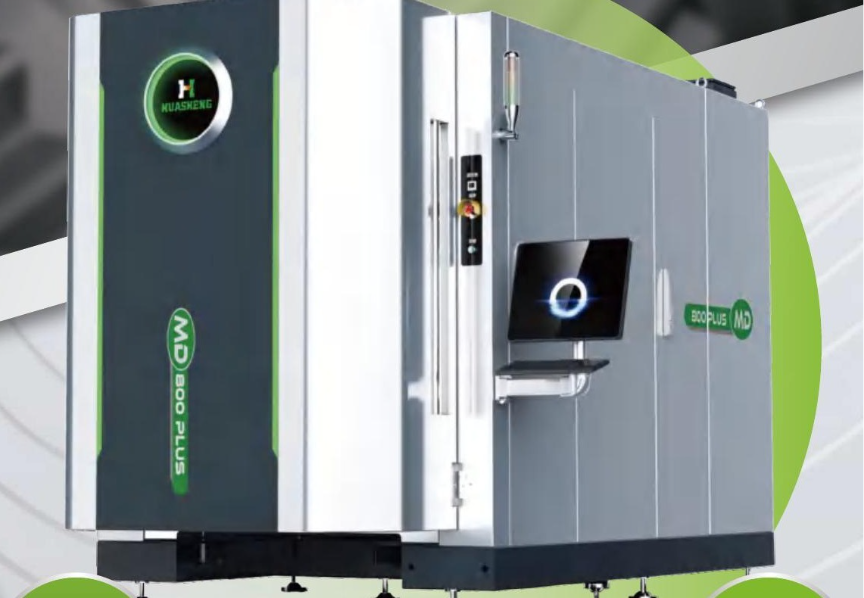
Huasheng's MD arc range runs from the MD200 through the MD500 and MD800 PLUS to the MD1500, a sixteen-source vertical machine with a Φ720 x 900 mm coating area that takes 72 hobbing tools in a batch. For broaches and other very long tools they build a dedicated machine with an effective coating area of Φ650 x 2000 mm in a 2.5 m3 chamber.
Hybrid and HiPIMS for Smoother Films
Where the film has to be smoother than arc alone will give, the hybrid platforms apply. GFOUR is Huasheng's fourth-generation hybrid machine, sold on a droplet-free surface and thick coatings up to 30 microns, aimed at indexable inserts and small cutting tools. The HD500 and HD800 combine arc with HiPIMS and are aimed at tools cutting hard-to-machine materials, stainless steels and titanium alloys.
For components rather than tooling, the WCC800 uses DC plus HiPIMS magnetron sputtering and Huasheng list it for components, tools and medical instruments. One trade-off to plan around: HiPIMS deposits more slowly than arc, which is why arc still dominates volume tool coating.
DLC and ta-C for Low Friction
Diamond-like carbon applies where friction matters more than hardness alone. Huasheng list the DLC machines for precision parts, shafts and bearing rings, automotive and electric vehicle components, textile machinery parts and lithium battery equipment parts. The TC800PLUS produces hydrogen-free ta-C up to 6000 HV, with a filtered-arc version, the TC800PLUS-F, using an S-shaped magnetic filter to block large particles.
For hydrogenated DLC there is the DLC800, with a Φ650 x 400 mm coating area, a 500 kg load and a process temperature below 200 °C, and the larger DLC1500 with a 2 m3 chamber and 1000 kg load.
Diamond Coating for Abrasive Materials
For machining graphite, composites, CFRP and hypereutectic aluminium above about 12 percent silicon, CVD diamond on carbide outlasts a PVD coating by a wide margin, though by how much depends on the material and the cut, so trial it on your own parts instead of taking a multiplier from a brochure. Lower-silicon aluminium alloys do not need it.
Two limits to check before you plan around it. Diamond is not for machining ferrous materials, because carbon diffuses into iron and the film graphitises. And the substrate preparation is specific: the cobalt has to be depleted from the carbide surface before deposition, or the coating will not adhere. Huasheng's DA600PRO has a 300 x 300 mm coating area and a cycle measured in tens of hours, so it is a specialist machine rather than a volume one.
Low Temperature Metal Ceramic
Huasheng describe LTMC as a low-temperature plasma CVD process, below 150 °C, forming a ceramic composite layer by diffusing silicon, boron and nitrogen into the near-surface region. The low process temperature is why it is used on finished and heat-treated parts. They list it for cylinder liners, piston rings, camshafts, bearings, gears and turbine blades, and also for carbide cutting tools, moulds and thread rolling dies.
One thing to raise at enquiry stage rather than at installation: the LTMC process gases bring their own storage, detection and statutory requirements on an Indian site. Which gases are involved, and what the site has to provide for them, is a discussion to have with us before the layout is fixed.
Utilities: What Delays Commissioning
Confirm these before the machine ships, not after it lands.
- Electrical supply: connected load, phases, and whether your existing supply carries it
- Cooling water: flow rate, inlet temperature, and whether a chiller is needed
- Process gases: argon, nitrogen, hydrogen and a hydrocarbon gas, depending on the process. Some processes need gases that bring licensing and gas-room requirements, so confirm which ones your process uses before the layout is fixed
- Compressed air: pressure and quality
- Floor area and height, including room to open the chamber and service the pumps
- Ambient conditions in the room itself
A machine that fits the floor plan but cannot be opened for maintenance, or that needs a gas supply nobody arranged, costs weeks at exactly the point when you want to be running production.
Inspection, Finishing and Stripping
These three rarely appear in the first budget and all three matter in the first year.
Inspection: coating thickness by calotest, adhesion by scratch or Rockwell indentation, and hardness. Budget for the instruments and the time. A customer who audits you will ask what you measure and how often, and the answer has to be a record rather than an assurance.
Post-coat finishing: edge honing or micro-blasting after arc coating, for the macroparticle reason above.
Stripping matters commercially. If you intend to take regrind and recoat work, and most commercial coating centres do, you need a stripping process for the substrate and coating combinations you handle.
Planning the Line as One Thing
Cleaning, heat treatment and coating are usually bought separately, often from different suppliers at different times. Each arrives working to its own specification, and the line still does not produce consistent results, because the specifications were set independently.
- Batch size: cleaning, furnace and coating chamber should handle comparable quantities, or one becomes the bottleneck
- Fixturing: jigs that carry parts through cleaning should suit the coating chamber, so parts are not rehandled between stages
- Temperature: tempering above coating, with the margin above
- Cleanliness: set by what the coating process requires, not chosen in isolation
Huasheng build a turnkey coating centre around the MD800 PLUS. For a greenfield tool-coating operation that can be the simpler route, but what falls inside the turnkey scope and what does not has to be established in writing at enquiry stage, because it decides what you still have to buy separately. A separate Novatec line makes more sense where the cleaning requirement is heavier than tool work needs, where parts are medical or where you already have coating capacity and are adding cleaning to it.
What to Ask Before You Commit
- Which coatings does this machine actually produce, and at what temperature?
- How many of my parts fit in one batch, with my fixturing?
- What is the cycle time for my coating on my parts?
- What cleaning standard does this coating process require?
- What are the full utility requirements, including gases and their handling?
- Who installs and commissions it, and who answers a technical question in year three?
- What is consumable, and what are the lead times on those items?
On the last two, ask for specifics. Arrangements differ by manufacturer, and it is better to know before the order than after.
Send Us Your Part Mix
The useful conversation starts with the parts: what they are, what they are made of, how many a month, and what the coating has to achieve. Chamber size, cleaning requirement and heat treatment route all follow from that.
Send us a description of the parts and the volumes and we will come back with a configuration and the questions we still need answered.
Contact Greets Equipment with your component list and we will tell you which family fits.
Frequently Asked Questions
- What does a PVD coating plant in India cost?
- The coating machine is usually the largest single item but not the whole cost. Factory preparation, electrical and gas supply, cleaning equipment, fixturing and spares all carry cost, and on an imported machine so do freight, duty and clearing. We quote against a defined part mix and monthly volume rather than in general terms.
- Do I need a cleaning line as well as a coating machine?
- For almost all applications, yes. PVD coatings are a few microns thick and adhesion depends on what is underneath. Ultrasonic cleaning is the usual route for tools and precision components because it reaches flutes, bores and complex geometries that spray washing reaches poorly.
- Does heat treatment have to happen before coating?
- Where the substrate needs hardening, yes. For hardened tool steels the tempering temperature should sit at least 25 to 50 degrees above the coating temperature, so the coating cycle does not temper the part a second time. This does not apply to carbide, which is not tempered, and it is not a constraint for the low-temperature DLC processes.
- Which coating technology suits cutting tools?
- Arc ion plating is the established route for TiN, TiAlN and AlCrN on cutting tools. Where the surface has to be smoother, hybrid arc plus HiPIMS platforms give denser films at a lower deposition rate. For graphite, composites and hypereutectic aluminium, CVD diamond on carbide is the usual answer.
- How long does installation take?
- That depends mainly on how ready the site is. Power, cooling water, process gases and floor preparation should be arranged before the equipment arrives. Installation and commissioning are carried out by the manufacturer, and the scope and timetable are set out in writing for each order.
- Can I start with the coating machine and add cleaning later?
- It can be done, but decide it deliberately. If a cleaning line is to follow, the interim cleaning arrangement still has to meet what the coating process requires, otherwise early results will be poor and the machine will be blamed for it.