



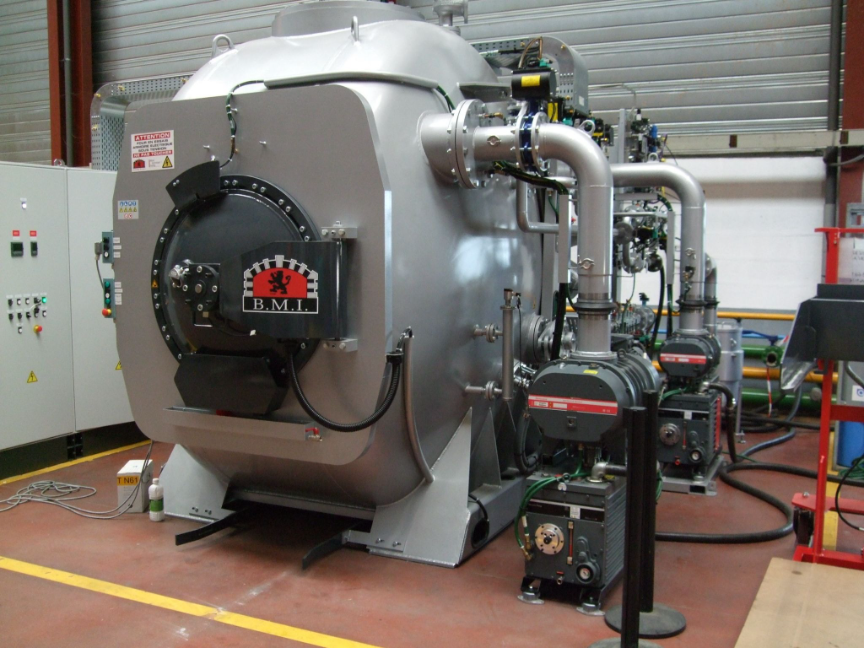
A vacuum heat treatment furnace is one of the larger capital decisions a heat treatment shop makes and one of the harder ones to reverse. It sets the size of part you can take, the processes you can offer and the cost per batch for the life of the machine.
Vacuum furnaces heat components in a chamber that has been evacuated before heating begins. Removing the atmosphere removes the oxygen that would otherwise react with the hot metal, so parts come out bright with no scale to remove.
Greets Equipment is an authorised Indian dealer for Fours Industriels B.M.I., the French vacuum furnace manufacturer. What follows is the furnace families, the specifications that decide between them, and the things that are cheaper to settle before an order than after.
Why Vacuum Rather Than Atmosphere
An atmosphere furnace heats in air or in a controlled gas atmosphere; a vacuum furnace evacuates the chamber before heating and works under vacuum or a controlled partial pressure. Atmosphere equipment generally costs less and suits high-volume work where surface finish is not critical. What you get for the extra outlay on vacuum:
- Parts come out bright, with no oxidation or scale to remove afterwards
- Temperature uniformity is held closely across the working zone and can be surveyed
- Surfaces stay clean, which matters if the part is to be coated or brazed next
- Results repeat batch to batch, with recorded process data for quality systems
- Distortion is easier to control than with atmosphere furnaces, particularly with gas quenching
So the decision comes down to the material, the volume, the surface quality specified and what happens to the part next. A component heading for PVD coating or vacuum brazing needs the clean surface; a high-volume part that will be ground afterwards may not.
The BMI Furnace Families
Knowing which family you are in narrows the choice to a handful of models.
Gas Quenching Furnaces
Gas quenching cools the load with circulated high-pressure gas and is the most common configuration. It suits gears, tool steels, dies and precision engineering components.
BMI's horizontal range runs from the B83T at 450 x 450 x 600 mm and 200 kg, through the B84T and B85T, to the B86T at 1000 x 1000 x 1500 mm and 2000 kg. A vertical range, VSE83T to VSE86T200, runs alongside it up to 3000 kg. Maximum temperature is 1250 °C to 1600 °C depending on configuration, and standard quench pressure is 5 bar with 12 bar available.
Note the steps are not even. The B85T is 900 x 700 x 1200 mm, not a smooth interpolation between its neighbours, so check your largest part against the actual model and not against the range.
Oil Quenching Furnaces
Where the material needs a faster cooling rate than gas delivers, oil quenching applies. BMI build these in single-chamber, dual-chamber, pit and vertical configurations.
One specification catches people out. Most of the oil quench range tops out at 1050 °C: the single-chamber furnaces, the pit furnaces P164TH and P165TH, and the vertical V64TH and V66TH furnaces. Only the horizontal dual-chamber furnaces, B63TH to B64TH Max, reach 1250 °C. High speed steel austenitises above 1180 °C, so a shop hardening HSS needs to check this before ordering. Oil also brings filtration, temperature control, extraction and disposal requirements that belong in the site plan, not in the commissioning week.
Vacuum Tempering and Low-Temperature Treatment
The vacuum purge tempering family, B53R through B56R180, is rated to a maximum of either 750 °C or 900 °C depending on configuration, and tempers well below that. COOL PLUS® sub-zero treatment and ALLNIT® low-pressure nitriding are offered as process options on this family rather than as separate machines.
On sub-zero: the martensite finish temperature of many tool and bearing steels lies below room temperature, so quenching to ambient leaves retained austenite behind. Cooling further continues that transformation and promotes fine carbide precipitation during the temper that must follow it. It is done promptly after quenching and before the final temper, not as a standalone step afterwards.
Thermochemical Treatment Furnaces
Where the surface chemistry has to change rather than just the structure. ALLCARB® is BMI's low-pressure carburising and ALLNIT® their low-pressure nitriding. They also build plasma nitriding furnaces, a vertical range to 600 °C, which BMI describe as an alternative to ALLNIT® for certain requirements. Which suits depends on the material, the case required and the part geometry.
Brazing Furnaces
Vacuum brazing joins components without flux, under vacuum or a controlled partial pressure. Filler metals containing elements with high vapour pressure need a partial-pressure backfill, which is a real configuration question and not an afterthought.
BMI build two separate ranges, and they are not interchangeable. Aluminium brazing furnaces, BA53 to BA56-250, run at around 700 °C. High-temperature brazing furnaces run from 1250 °C to 1500 °C, and the range extends to very large chambers: the B59T700 takes a 20000 kg load in a working zone of 2500 x 1500 x 7000 mm. Make sure an enquiry specifies which.
Which Applications Need One
The four groups below account for most Indian vacuum furnace enquiries, and each one pushes the specification in a different direction.
Automotive and EV Components
Gears, transmission parts, drivetrain components and shafts where hardness, wear resistance and dimensional stability are specified. Low-pressure carburising is widely used here: it gives a uniform case in blind holes and small bores with no intergranular oxidation, and because it pairs with high-pressure gas quenching rather than oil, distortion is usually lower.
Cutting Tools, Dies and Moulds
Tool steels and die steels hardened and tempered to a defined hardness. Where the tool will be PVD coated afterwards. For hardened tool steels the tempering temperature has to sit above the coating temperature, which is covered in our article on setting up a PVD coating plant.
Aerospace and Defence
Specialised alloys with tight process control and documentation requirements. Pyrometry and traceability for aerospace work are set by AMS 2750. Compliance is a specification and instrumentation option on the furnace rather than standard on every configuration, so confirm the revision your customer works to and have the furnace quoted against it. Note that Nadcap accredits the heat treater, not the equipment: a furnace can be specified to support approval, it cannot itself be approved.
Medical and Precision Engineering
Implant components and surgical instruments are often processed in small batches to tight dimensional tolerances, and the bright finish from vacuum treatment matters because these parts usually go on to cleaning, passivation and inspection stages where surface condition is checked. Batch traceability is normally a requirement, not a preference.
Ten Things to Evaluate
- Component material and dimensions: the alloys to be treated, with maximum part weight, geometry and how the load will be arranged
- Working zone and batch capacity. Size for current production with headroom, but an oversized furnace costs more to run on every small batch
- The process you actually need. Not every furnace supports every process, and retrofitting one later is rarely economic
- Temperature range and uniformity, with the tolerance across the working zone and how it is measured and recorded
- Quench pressure and cooling performance. On the gas quenching furnaces BMI's standard is 5 bar with 12 bar available; the other families quench at much lower pressures, so check the figure for the furnace you are actually buying. Check the resulting cooling rate against your material at your section thickness
- Automation and process control: programmable recipes, data logging, alarms, and how records reach your quality system
- Energy and utilities: connected load, cooling water flow and temperature, gas supply, compressed air. Confirm the factory carries it before ordering
- Maintenance and spares. Pumps, heating elements, insulation and seals are consumables; ask about service intervals and lead times
- Installation space: footprint, height, floor loading, foundation, and access to open the furnace and pull the hot zone
- Technical support in India: who installs, who commissions, who trains the operators, who answers in year three
What Affects the Cost
There is no list price, because configuration drives it: working zone, quench system and pressure, hot zone construction, automation, the instrumentation your quality standard needs, and any customisation.
Beyond the machine: sea freight and insurance, customs duty and clearing, factory preparation and foundation, electrical and utility connections, installation and commissioning, operator training, initial spares and annual maintenance. These are not small relative to the machine, and they are the items most often left out of the first budget.
Compare specifications rather than headline figures. Two furnaces quoted at similar numbers can differ in working zone, quench pressure, hot zone life, instrumentation and scope. On an imported machine, check the currency, the validity period and what the offer includes before comparing two quotations.
Buying Through Greets Equipment
We help with equipment selection, starting from your parts rather than a furnace model, and we coordinate the quotation, shipping and import documentation with BMI. Installation, commissioning, operator training and after-sales support are arranged with BMI and set out in writing for each order, so the scope and who is responsible for what are clear before you commit.
What to Pin Down in the Offer
The ten points above are the technical specification. These four are commercial, and they are the ones that get left vague:
- What is in the quotation and what is extra
- What warranty applies, what it covers, and for how long
- What spares to hold from day one, and the lead time on each
- Whether the furnace has headroom for what you expect to be making in five years, since a working zone cannot be enlarged later
Find the Right Furnace for Your Parts
The quickest way to a useful answer is your component list: alloys, the largest part, the hardness or case depth specified, and monthly volume. From that we can say which BMI family fits and where the specification still has gaps.
Contact Greets Equipment with your component list and we will tell you which family fits.
Frequently Asked Questions
- What is a BMI vacuum furnace used for?
- Controlled heat treatment of metal components, tools and dies: hardening, tempering, carburising, nitriding, brazing and sub-zero treatment, depending on configuration. It is specified where surface condition, dimensional stability and repeatability matter.
- Which vacuum furnace suits automotive components?
- It depends on material, geometry, hardness specification and process. Gas quenching furnaces are common for gears and transmission parts. Low-pressure carburising is widely used where case depth is specified, because it gives a uniform case in blind holes and small bores without intergranular oxidation.
- What is the difference between gas quenching and oil quenching?
- Gas quenching circulates high-pressure gas, usually nitrogen, to cool the load. Oil removes heat faster at ordinary quench pressures, so it suits lower-hardenability materials and heavier sections. High-pressure gas quenching narrows the gap. What decides it is your material and section thickness, not the medium in the abstract.
- Can a vacuum furnace do low-pressure carburising?
- Yes, with the right configuration. ALLNIT® and ALLCARB® are BMI's low-pressure nitriding and carburising processes. Confirm the process capability when the furnace is specified instead of planning to add it later.
- What temperature do oil quenching furnaces reach?
- BMI's single-chamber oil quenching furnaces are generally offered to 1050 °C, and so are the pit and vertical dual-chamber furnaces. Only the horizontal dual-chamber range, B63TH to B64TH Max, goes to 1250 °C. High speed steel austenitises above 1180 °C, so check the furnace temperature against your material before ordering.
- What should I check before buying a vacuum furnace in India?
- Working zone and load capacity, process capability, temperature uniformity and how it is verified, quench pressure against your material and section, utility requirements, installation arrangements, maintenance intervals, spares availability and who provides technical support locally.